

Organic-PLUS’s MODEL workpackage (WP6) is dedicated to assessing the environmental impacts of both contentious inputs and their potential replacements; we want to ensure that any alternative inputs or practices really do improve organic. One way we are doing this is the use of Life Cycle Assessment (LCA) tools.
LCA is an internationally recognised way of conducting environmental quantifications (recognised by the UN Environment Programme and European Commission). There are, however, several criticisms that could be made when LCA is applied to organic production systems – in particular, areas such as biodiversity which are not wholly accounted for. Being aware of its potential but also of the limitations, it has been the ambition of Organic-PLUS to take advantage of the holistic vision of LCA; meaning the inclusion of the whole production chain from cradle to farm gate and multi-criteria environmental indicators and also to improve the methodology to make LCA more suitable for assessing organic production systems.
Based on information collected from Organic-PLUS partners across Europe, researchers at Catalonian partner, the Institute of Agrifood Research and Technology (IRTA) have conducted environmental assessments of: aubergine (Turkey), lemons (Sicily), tomatoes (Spain), olives (Greece) poultry (Poland), lamb (Norway) and pigs (Denmark). Using these examples as reference scenarios, the team used LCA methodology to compare contentious inputs with potential alternatives.
On 11th May 2021, IRTA hosted a webinar for 28 attendees from across the Organic-PLUS partners. IRTA presented the environmental assessments already conducted, the results obtained, highlighted the methodological problems and sought feedback on how to advance the environmental assessment of organic production systems.
The first half of the webinar provided a brief description of LCA methodology, showing two examples of the case studies conducted: Sicilian organic citrus production and Norwegian organic sheep production. In the second part, three specific presentations were made and highlighted the main methodological limitations that had been found: lack of suitable datasets, dealing with the toxicity assessment of inorganic substances and biodiversity indicators. This work has resulted in advancements in some of these weaker areas and has highlighted areas where further research is needed.
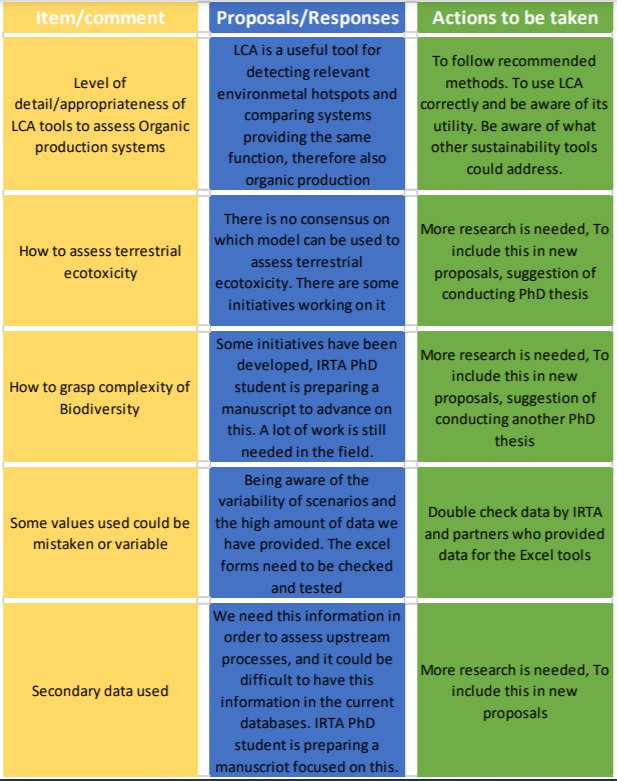
Some very interesting discussions took place during the session – the table below summarises the most important points discussed/commented on, including answers and actions required. It can be concluded that there are clear benefits to the LCA method in terms of comparisons and hotspot analysis, but due to the complexity of assessing environmental questions, more research is needed to adapt it to organic production. In particular, more work is needed on biodiversity indicators and terrestrial ecotoxicity impacts.
 organic-plus.net